Luminal AI
%20--%3e%3cdefs%3e%3cstyle%3e%20.st0%20{%20fill:%20%235aaa5a;%20}%20.st1%20{%20isolation:%20isolate;%20}%20.st2%20{%20fill:%20%231d2e1b;%20}%20%3c/style%3e%3c/defs%3e%3ccircle%20class='st2'%20cx='54'%20cy='54'%20r='54'/%3e%3ccircle%20class='st0'%20cx='54'%20cy='54'%20r='30.3'/%3e%3cg%20class='st1'%3e%3cpath%20class='st0'%20d='M182.4,88V17h8.6v67l-4.3-4.4h39.7v8.4h-44Z'/%3e%3cpath%20class='st0'%20d='M262.3,89.6c-7.5,0-13.3-2.4-17.6-7.1-4.3-4.7-6.4-11.2-6.4-19.3V17h8.6v46.2c0,5.9,1.3,10.3,3.9,13.4,2.6,3.1,6.5,4.6,11.5,4.6s8.8-1.5,11.5-4.6c2.6-3.1,3.9-7.5,3.9-13.4V17h8.6v46.2c0,8.1-2.1,14.6-6.4,19.3-4.3,4.7-10.1,7.1-17.6,7.1Z'/%3e%3cpath%20class='st0'%20d='M318.5,80l-13.4-55h.8v63h-8.6V17h13l14,58.4h-4l14-58.4h13v71h-8.6V25h.8l-13.4,55h-7.6Z'/%3e%3cpath%20class='st0'%20d='M360.3,88v-8.4h17.7V25.4h-17.7v-8.4h44v8.4h-17.7v54.2h17.7v8.4h-44Z'/%3e%3cpath%20class='st0'%20d='M419.3,88V17h12.2l26.7,64.9-1.5.3V17h8.6v71h-12.2l-26.7-64.9,1.5-.4v65.3h-8.6Z'/%3e%3cpath%20class='st0'%20d='M474.9,88l21.6-71h11.6l21.6,71h-9.2l-18.2-63.2-18.2,63.2h-9.2ZM485.8,67.8l3-8.4h27l3,8.4h-33Z'/%3e%3cpath%20class='st0'%20d='M542.3,88V17h8.6v67l-4.3-4.4h39.7v8.4h-44Z'/%3e%3c/g%3e%3c/svg%3e) Apply
ApplyAbout
Luminal builds an AI inference compiler that optimizes models for GPUs and ASICs, delivering the fastest, highest-throughput inference by treating compilation as a search problem.
A technical challenge for the 3blue1brown audience
This take-home exercise is for candidates joining the compiler engineering team at Luminal. It evaluates instruction scheduling, scratch allocation, correctness, and engineering judgment when building a compiler backend.
Build a general backend compiler for a small, deterministic VLIW machine. The input is a typed, straight-line SSA program. Your compiler must assign every virtual value to the machine's scratchpad and schedule every operation into VLIW bundles. Correctness is required; shorter schedules and smaller scratch footprints score better.
The Compiler ChallengeFeatured work
Compiling models to megakernels
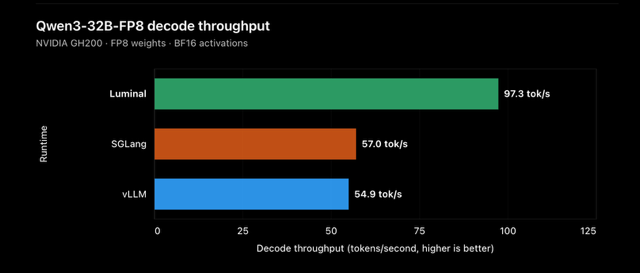
Standard GPU inference wastes time on kernel launch overhead, uneven work distribution, and memory access delays between operations. Luminal's compiler fuses entire neural network models into single GPU kernels — megakernels — using a dynamic global instruction queue that schedules work across streaming multiprocessors at runtime, eliminating the gaps that conventional approaches leave behind.
 Read the post
Hardware arbitrage with Luminal and Positron AI
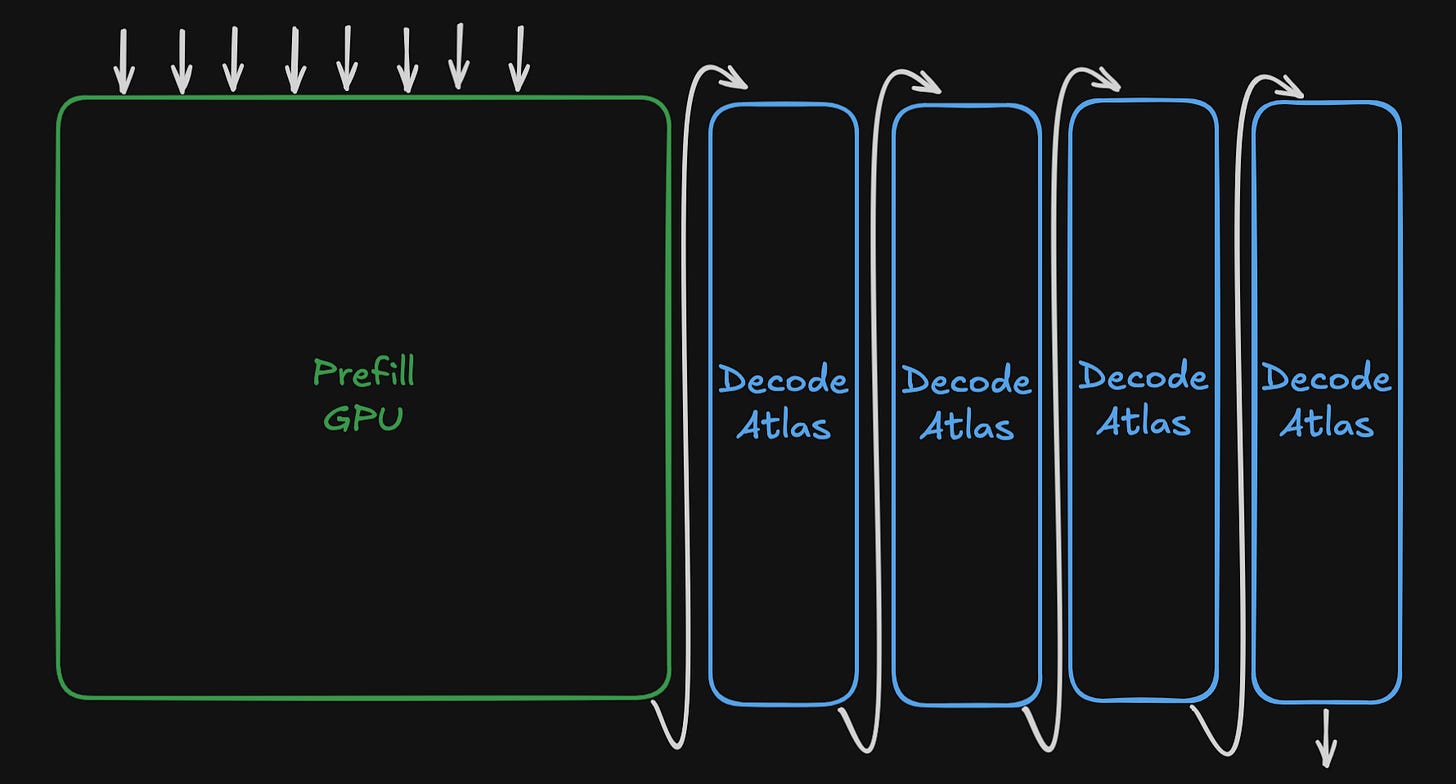
Different inference workloads have fundamentally different hardware needs: prefill is compute-bound while decode is bandwidth-bound. Luminal's compiler automatically routes each phase to the hardware it's best suited for — GPUs for prefill, Positron Atlas systolic arrays for decode — transferring KV cache between systems to squeeze out the maximum performance from heterogeneous infrastructure.
 Read the post
Message from Grant
There were a few phrases that stood out to me after chatting with the Luminal team. One was that "search space design is under-appreciated".
It helped to read through this GitHub repo of theirs to better understand what they were getting at, and more generally to get a concrete sense of their design opinions. For example, you'll find in there a lot of the same philosophy underlying RISC, i.e. efficiency is downstream of reducing to as small a vocabulary of instructions as possible. This goes hand-in-hand with the idea of search space design. The goal is to give a compiler a well-thought-out space to explore, and its job is to find the optimization, rather than relying on our own intuition to bake in hand-tuned heuristics.
There's something pleasingly meta about how this design philosophy is reflected in how the organization is run. The team is lean, and a repeated theme I heard from people there was the pride each one takes in having real responsibility. This strikes me as analogous to the philosophy for how to optimize a kernel, i.e. not by hand-tuning the method, but by designing an effective search space and letting optimizations be found automatically within it. At the level of running an org, you get the most out of a team by setting up the right culture and environment, and from there endowing each person with real agency and trust.
What's clear in talking to the team is how much everyone appreciates that agency. The other phrase that stood out from our conversation was that "you can move mountains with a sufficient combination of ambition and pragmatism."