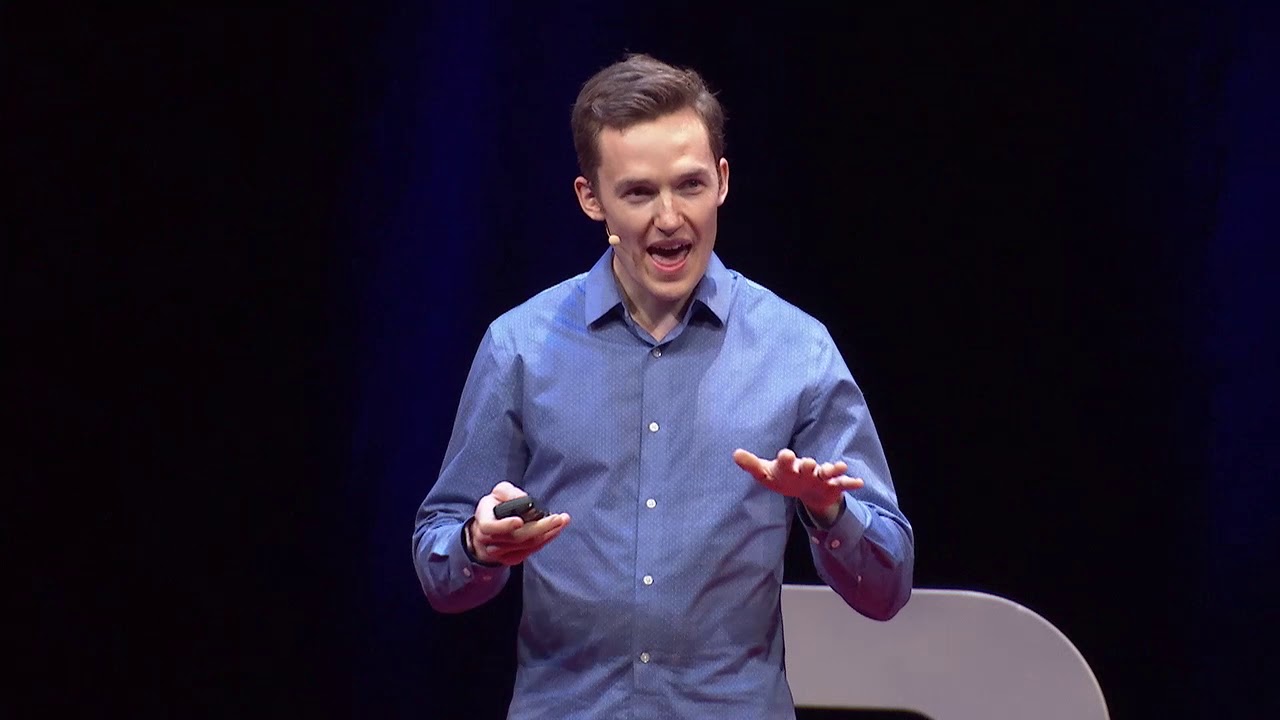
What "Follow Your Dreams" Misses | Harvey Mudd Commencement Speech 2024
I had the honor and pleasure of being invited to give Harvey Mudd's commencement speech this year.
Thank you President Nembhard and the rest of the faculty for inviting me today, I could not be more honored to be here. I had the joy of getting to know many of you in this year's graduating class on a visit last year, and I left feeling that a future in your hands is a bright future indeed.
For those of you who don't know me, I make online lessons about math aimed at understanding the topic through visualizations. It's a weird job, but I do love it, it's no exaggeration to describe it as a dream job.
A common cliché is for someone lucky enough to have wound up in a dream job to stand before a class of fledgling graduates confidently compelling them all to follow their dreams. Frankly, though, on its own, this is not very good advice.
There is truth behind the cliché. It's true that those who make the biggest ripples in the world are fueled by passion, it's true that life is much more enjoyable if you love what you do, and it's true that you shouldn't feel bound by societal norms.
But for one thing, not everyone has a pre-baked dream ready to follow, and that's completely okay. And even if you are lucky enough to have a passion you'd like to shape into your career, there are pragmatic concerns that don't always fit neatly into inspirational talks to give this the best shot of working.
Given what a nerdy audience I know I'm talking to, I'm tempted to phrase my aims here more precisely in the language of linear algebra, where in the vector space of all advice, if you consider the "follow your dreams" vector I'd like to explore its orthogonal subspace. But maybe it's better if instead, I start with a story.
A shifting goal
Before I entered college I knew what I wanted to major in: No surprises here, it was math, I had loved the subject since I was young. During college I was also compelled by the seductions of computer science and programming, spending summers interning for software startups, but at the end of every summer, I'd always come back to the thought that what I really wanted with my life was to spend more time doing math.
In hindsight, that passion was a lot more arbitrary and self-centered than I would have liked to admit at the time. Why did I love math? It likely had roots in the fact that when I was little, adults signaled that it was important and told me I was good at it. This made me spend more time with it, and time spent with a subject is how you get better at it, so this kicked off a positive feedback cycle.
As time went on it was less about perceptions, by the time I was in college I was genuinely compelled by the pure aesthetic delights that great mathematical problem-solving has to offer. But, as a career ambition, that still had the flaw that I was viewing my future plans through the lens of what I enjoyed, without enough consideration for how exactly it would add value to others.
I don't know if you've felt it yet, but today marks a day when a fundamental goal in your life changes. As a student, your main job is to grow and become a better person, and so many structures around you are designed to help you and reward you for doing just that. Learn more, gain skills, broaden your worldview. In life after school, the goal changes. Success hinges on how much you add value to other people. That's not incompatible with improving yourself. After all, you're much better positioned to make a difference armed with an expertise, and sometimes you have to put on your own oxygen mask to be able to help others. But there's a big difference between personal growth being an end in and of itself vs. being a means to an end.
As an analogy, imagine two music students, let's call them Paganini and Taylor. Both are talented, but Paganini pushes for technical excellence and perfects virtuosically challenging pieces. Taylor strives to write music that speaks to people, focusing on what resonates emotionally with others. In a music school, Paganini will always get higher marks, and better placements, but if both of them try to forge careers as musicians, Taylor is at the clear advantage.
If I could go back in time, one thing I'd tell my past self, and this is my first piece of advice for you, is that if you have a passion you'd like to incorporate into a career, step back and think about the fact that this passion grew in a phase of your life when the number one goal was to learn and improve yourself, and now you're transitioning to a time when the primary aim is to add value to others. The "follow your dreams" cliché overlooks how crucial it is for those dreams to be about something more than yourself.
Those who excel in their first job focus on making life easier for those they work with, even when it involves tasks they don't love. Those who succeed in PhDs are the ones who understand how their work can complement the broader research community, rather than those who simply view it as another chapter of school. Successful entrepreneurs focus on whether people want to buy what they have to sell, rather than on making something that looks impressive.
Action precedes motivation
If you don't yet have some defining passion, if the phrase "follow your dreams" falls flat for want of a clear dream, there's nothing wrong with that. You'll do just as well if you start by seeking opportunities where the skills you've developed enable you to add value to others. If you find that, the passion will follow.
One of the best pieces of advice I ever heard is "Action precedes motivation". This is often useful on a smaller scale. We feel most awake after getting out of bed, not before. A drive to exercise comes from the habit of exercising, not the other way around.
The idea that action precedes motivation also applies to this larger question of finding a career doing what you love. These days I love making videos, and I love teaching, but when I was finishing college I had no penchant for video production, and my interest in teaching was honestly just a function of how well it scratched the itch to do more math. It was only by stumbling into both that I came to love them.
Choosing the right game
In my own story, what happened after graduating involved a fair bit of luck, but luck can take many forms, and with a little forethought, you may be able to avoid relying as much on chance.
There's a post on the webcomic xkcd showing a man on a stage surrounded by large bags of cash. "Never stop buying lottery tickets", he says, "no matter what people tell you! I failed again and again, but never gave up, and here I am as proof that when you put in the time, it pays off!" The caption notes that every inspirational speech should have a disclaimer about survivorship bias.
The obvious way that the "follow your dreams" advice is susceptible to survivorship bias is that for all the high-risk and high-reward paths, like professional athletics, starting a social media company, making a career in the arts, and so on, only the few who rise to the top are in a position to give advice at all.
There's also a more subtle form of survivorship bias at play here, which has less to do with your odds of winning a particular game, and more to do with whether the game you choose happens to mesh well with the way the future unfolds. Someone passionate about software in the late 80s would be well poised to ride the dot-com boom. People with a niche interest and a knack for film production had an unexpected opportunity when YouTube and other social media rose in prominence.
As I was finishing my undergrad, one way I scratched the itch to do more math was to hack together a rudimentary Python library for making math visualizations, and use it to make some videos about nice problems and proofs, posting them online. I wasn't planning on it being a career, but I did appreciate how valuable personal projects can be.
This led to conversations with Khan Academy that turned into a job there making more lessons online. In the meantime, my channel remained a side hobby, and it slowly grew a modest following of others who enjoyed visualizing math the way I did.
My original plan was to spend a year or two at Khan Academy before returning to pursue a PhD. Eventually, though, some combination of the gratitude I saw from students around the planet for the lessons and the slow but steady growth I saw in my channel led me to double down forging a somewhat unorthodox career in online lessons and math visualizations.
Looking back, it would feel incomplete to attribute any success I found to the fact that I was pursuing a passion. Passion plays into it, you can't have good lessons without a teacher who cares, but we can't ignore the other factors at play.
I already brought up the biggest factor. Success is a function of the value you bring to others, so a pursuit equally fueled by love but which didn't help or entertain anyone just wouldn't have worked. But another factor in my case was being relatively lucky with the timing.
Had I been born 10 years earlier, I couldn't have reached the same number of people posting lessons on a much less mature version of the internet, and much less infrastructure would have existed to make a career doing so. If I had started 10 years later, the space would have been much more saturated.
So another piece of advice I'd like to offer, another ingredient that makes following your dreams a little more likely to work out, is to ask yourself what's possible now that wasn't possible 10 years ago, and which might become much harder 10 years from now.
There are more opportunities in a less crowded landscape, and more chances to grow if you find a rising tide, but doing so requires pushing past the discomfort of following a path with little or no precedent.
The dreams of others
Next, let's talk about whose dreams you should think about because it's not just your own.
When I visited Harvey Mudd last year, I asked one of the gems in your math department, Talithia Williams, what made her pursue math in the first place.
She told me she hadn't thought about it until one day in her senior year of high school, when her calculus teacher Mr. Dorman pulled her aside and said "Talithia, you're really good at this, you should consider being a math major." That one comment was evidently enough to knock over the first in many dominoes leading to a successful career in the field.
I've asked many mathematicians this question, and it's remarkable how often I hear a similar answer, about one particular teacher, and one seemingly small point of encouragement. Never underestimate how much influence you can have on others, especially those younger than you. Sometimes one acute comment can completely change a person's trajectory.
Growing older is a process of slowly seeing the proportion of people around who are younger than you rise closer and closer to 100%. As this happens, you stand to have as much influence by shaping the dreams of others as you do following your own.
What should you follow?
As a final point, the biggest risk of the "follow your dreams" cliché is the implication that there should be any static target point at all.
In the next 10, 20, 30 years, the world around you will change a lot, and those changes will be unpredictable. I hardly need to emphasize this point, given that you're the class who spent your formative transition years from high school to college in a pandemic.
And it's not just the world around you. As you celebrate your graduation this evening, take a few moments to ask those older than you how their personalities and value systems have changed since being a student. You'll notice that essentially all of them have an answer, so you have every reason to expect that you yourself will change a lot in the coming decades, also unpredictably.
Almost everyone I know has undergone some significant change since college. Some now place more value on having a family than they used to, some regret doing grad school and wish they'd gone to industry, some left careers in industry to go to grad school, and so many are doing jobs that simply didn't exist at the time of graduation.
Rather than having any one particular goal that defines you, you'll take better advantage of whatever the future holds by remaining nimble and responsive to the changes in the world, and anticipating change in yourself.
Don't treat passion as something to follow. Think of it as an initial velocity vector. It gives a clear direction to point yourself, and loving what you do can get you moving quickly, but you should expect and even hope that the specific direction you're moving changes.
In these unpredictable decades to come, your generation holds the most sway over how it unfolds, and you, the graduating class of Harvey Mudd, represent some of the most talented and thoughtful minds in that generation. Influence is not distributed evenly across the population, and I, for one, would feel a lot more comfortable if you were the ones at the helm, guiding this crazy ship we're all riding.
If you step into this next chapter of life with an implacable focus on adding value to others, you're more likely to be at the helm.
If you recognize that action precedes motivation, you're more likely to be at the helm.
If you ask what's possible now that wasn't 10 years ago, you're more likely to be at the helm.
If you appreciate just how much power you have to shape the lives of the generation behind you, you're more likely to be at the helm.
And if you remain adaptable to a changing world, treating passion not as a destination but as fuel, following not dreams but opportunities, you're more likely to be at the helm.